


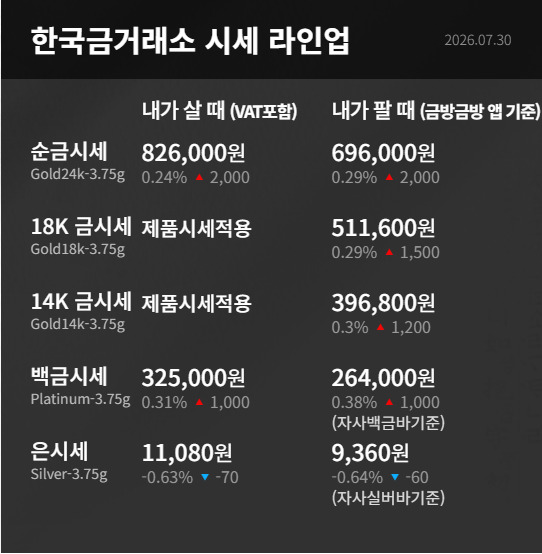
[CBC뉴스] 2026년 7월 30일 기준 한국금거래소 시세에 따르면 순금(24K·3.75g) 시세는 살 때 82만6,000원, 팔 때 69만6,000원으로 집계됐다. 살 때 가격은 전 거래일 대비 0.24% 상승하며 2,000원 올랐고, 팔 때 가격도 0.29% 상승해 2,000원 상승했다.
18K 금 팔 때 가격은 51만1,600원으로 나타났다. 전 거래일 대비 0.29% 상승하며 1,500원 올랐다.
14K 금 팔 때 가격은 39만6,800원으로 집계됐다. 전 거래일 대비 0.3% 상승해 1,200원 상승했다.
백금(Platinum·3.75g)은 살 때 32만5,000원, 팔 때 26만4,000원을 기록했다. 살 때 가격은 전 거래일 대비 0.31% 상승하며 1,000원 올랐고, 팔 때 가격도 0.38% 상승해 1,000원 상승했다.
은(Silver·3.75g)은 살 때 1만1,080원, 팔 때 9,360원으로 집계됐다. 살 때 가격은 전일 대비 0.63% 하락하며 70원 내렸고, 팔 때 가격도 0.64% 하락해 60원 떨어졌다.
한편
뉴욕 금융시장에서 금과 은을 비롯한 귀금속 시장이 강세를 나타낸 가운데, 투자자들은 미국 증시 변동성과 향후 금리 전망 변화를 함께 주시하는 모습이었다. 미국 증시가 대형주와 중소형주를 가리지 않고 일제히 밀리고 달러가 약세를 보이면서 귀금속 시장에도 매수세가 유입됐지만, 이번 흐름을 단순한 위험자산 회피만으로 해석하기는 어렵다는 평가도 나온다.
다우존스30산업평균지수는 전 거래일보다 1,152.46포인트(2.18%) 하락한 51,551.18로 장을 마쳤다. S&P500지수는 112.38포인트(1.51%) 내린 7,313.92를 기록했고, 나스닥종합지수는 433.97포인트(1.74%) 떨어진 24,425.34에 거래를 마감했다. 중소형주 흐름을 보여주는 러셀2000지수 역시 1.60% 하락한 2,902.71을 기록했다.
매도 압력이 다우와 나스닥 등 주요 지수뿐 아니라 중소형주로까지 확산했다는 점은 시장 전반의 투자심리가 위축됐음을 보여준다. 다만 금 가격은 주식시장 흐름 외에도 달러 가치와 미국 국채금리, 실질금리, 중앙은행 매입 수요 등 다양한 변수의 영향을 받는 만큼 이번 귀금속 강세 역시 여러 요인이 복합적으로 작용한 결과로 해석된다.
뉴욕증시 약세의 배경에는 연방준비제도의 통화정책과 국제유가 흐름, 인공지능(AI) 관련 기업들의 실적 부담 등이 복합적으로 작용했다. 특히 최근 미국과 이란 간 군사 충돌 이후 국제유가가 급등하면서 인플레이션 우려와 금리 부담이 커졌고, 이 과정에서는 금 역시 국채금리 상승 압력의 영향을 받아 상승세가 제한되는 모습을 보인 바 있다. 이번 귀금속 강세 역시 당시와는 달라진 금리 및 달러 흐름이 일부 반영된 결과라는 분석이 나온다.
이처럼 인공지능과 반도체 관련 종목의 변동성이 커지는 환경에서는 일부 투자자들이 자산 배분 차원에서 귀금속 비중을 확대하는 움직임이 나타날 수 있다. 다만 금 가격은 기업 실적이나 증시 흐름만으로 결정되지 않으며, 미국 국채금리와 달러 가치, 통화정책 전망 등 거시경제 변수의 영향을 함께 받는다.
기업의 예상 이익이 낮아지거나 할인율 역할을 하는 국채금리가 오르면 성장주의 현재 가치는 빠르게 낮아질 수 있다. 반대로 금리가 안정되거나 달러가 약세를 보일 경우에는 귀금속 투자심리가 개선되는 사례도 나타난다. 이에 따라 금시장 흐름은 주식시장과 동일한 방향으로 움직이지 않을 수도 있다.
금은 배당이나 영업이익, 기업 실적과 직접 연결되는 자산이 아니다. 이 때문에 금융시장 변동성이 확대되거나 통화정책 전망이 변화하는 국면에서는 포트폴리오 분산 수단 가운데 하나로 활용되는 경우가 많다.
귀금속 시장의 강세는 금에만 그치지 않았다. 은 현물 가격과 백금도 강세를 보였고 팔라듐 역시 상승했다.
금과 은, 백금, 팔라듐이 함께 상승했다는 점은 매수세가 특정 품목에만 집중된 것이 아니라 귀금속 시장 전반으로 확산했음을 보여준다. 다만 이번 흐름을 단순히 지정학적 긴장에 따른 안전자산 선호로만 해석하기는 어렵다. 최근 미국과 이란 충돌 과정에서는 국제유가 급등이 인플레이션과 금리 우려를 자극하며 금 가격에 부담으로 작용했던 만큼, 이번 상승은 달러 흐름과 금리 전망 변화, 투자심리 개선 등이 함께 반영된 결과로 보는 시각이 우세하다.
은은 금과 비슷한 귀금속이지만 산업용 비중이 높은 원자재라는 특징도 갖고 있다. 태양광 패널과 반도체, 전기차, 전자기기 등 다양한 산업에서 활용되는 만큼 투자 수요와 제조업 경기 전망의 영향을 동시에 받는다.
이번 거래에서 은 가격이 금보다 더 큰 폭으로 오른 것은 귀금속 투자심리 개선과 함께 산업용 수요에 대한 기대가 반영된 영향으로 풀이된다. 귀금속 전반으로 자금이 유입되는 과정에서 가격 변동성이 상대적으로 큰 은에 매수세가 집중된 측면도 있는 것으로 분석된다.
일반적으로 증시가 급락하면 경기 둔화 우려로 산업용 금속 수요가 감소할 수 있다는 전망이 나온다. 다만 은은 산업재이면서도 귀금속이라는 이중적인 성격을 지닌 만큼 당시 시장에서 반영된 다양한 거시경제 변수의 영향을 함께 받은 것으로 해석된다.
The precious metals market, including gold and silver, posted strong gains in New York trading as investors assessed both heightened volatility in U.S. equities and shifting expectations for future interest rates. While buying interest flowed into precious metals after broad-based declines across U.S. stock markets and a weaker U.S. dollar, market observers cautioned against interpreting the rally solely as a traditional flight to safe-haven assets.
The Dow Jones Industrial Average fell 1,152.46 points, or 2.18%, to close at 51,551.18. The S&P 500 declined 112.38 points, or 1.51%, to 7,313.92, while the Nasdaq Composite dropped 433.97 points, or 1.74%, to finish at 24,425.34. The Russell 2000 Index, which tracks small-cap stocks, also lost 1.60% to close at 2,902.71.
The sell-off spread beyond large-cap stocks to the broader market, including small-cap shares, highlighting weaker overall investor sentiment. However, analysts noted that gold prices are influenced by a wide range of factors—including the U.S. dollar, Treasury yields, real interest rates, and central bank purchases—meaning the latest strength in precious metals likely reflects multiple forces rather than equity market weakness alone.
Several factors contributed to the decline in U.S. equities, including expectations surrounding Federal Reserve monetary policy, movements in crude oil prices, and earnings-related pressure on artificial intelligence (AI) companies. In particular, after the recent military confrontation between the United States and Iran triggered a sharp rise in global oil prices, concerns over inflation and higher interest rates intensified. During that period, rising Treasury yields limited gains in gold despite geopolitical tensions. Analysts therefore suggest that the latest rebound in precious metals reflects a different market environment, with changing interest rate expectations and a softer U.S. dollar playing a more significant role.
As volatility continues to affect AI and semiconductor-related stocks, some investors appear to be increasing their allocations to precious metals as part of broader portfolio diversification strategies. Nevertheless, gold prices are not determined solely by corporate earnings or equity market performance; macroeconomic factors such as Treasury yields, the value of the U.S. dollar, and monetary policy expectations remain key drivers.
When corporate earnings expectations weaken or Treasury yields—which serve as a discount rate for future cash flows—rise, the present value of growth stocks can decline rapidly. Conversely, periods of stable interest rates or a weaker dollar have often supported stronger investor demand for precious metals. As a result, gold does not necessarily move in tandem with the stock market.
Unlike equities, gold does not generate dividends or corporate earnings. Instead, it is widely used as a portfolio diversification tool, particularly during periods of heightened financial market volatility or changing monetary policy expectations.
The rally extended beyond gold. Spot silver prices, platinum, and palladium also recorded gains.
The simultaneous advance in gold, silver, platinum, and palladium suggests that buying interest broadened across the precious metals complex rather than concentrating on a single asset. However, analysts argue that the move should not be viewed simply as a safe-haven response to geopolitical tensions. During the recent U.S.-Iran conflict, soaring oil prices fueled inflation concerns and expectations of higher interest rates, creating headwinds for gold. This time, the stronger performance in precious metals appears to reflect a combination of a weaker dollar, evolving interest rate expectations, and improving investor sentiment.
Although silver is classified as a precious metal alongside gold, it also plays a significant role as an industrial commodity. It is widely used in solar panels, semiconductors, electric vehicles, and consumer electronics, making its price sensitive to both investment demand and manufacturing activity.
Silver's stronger performance relative to gold in the latest session is therefore seen as reflecting not only improving sentiment toward precious metals but also optimism surrounding industrial demand. Analysts also note that silver's relatively higher price volatility may have attracted additional buying as capital flowed into the broader precious metals sector.
Typically, sharp declines in equity markets raise concerns about slowing economic growth, which can weigh on demand for industrial metals. Silver, however, occupies a unique position as both an industrial metal and a precious metal. Its latest gains are therefore viewed as the result of multiple macroeconomic factors influencing the market simultaneously, rather than a single dominant catalyst.
[투자 판단은 각자의 책임이며, 단기 변동성이 확대된 만큼 신중한 접근이 요구된다.]
★ 네티즌 어워즈 투표하러 가기 ▶
★ 전 세계 팬덤의 결집, cbcglobe.com ▶
★ 돈돈돈, 남몰래 혼자 보는 – 돈 되는 뉴스 ▶
▮ CBC뉴스ㅣCBCNEWS 권오성 기자